
Are You Finished Yet? How to avoid overworking your coloring.
This article is part of the Vanilla Arts archive and may reference older supplies, discontinued products, or outdated links.
Looking for my current lessons and resources?
→ Visit MarkerPencil.com

ARE YOU KILLING YOUR COLORING?
Part of learning and growing, is to stop making stupid mistakes, right?
But there's one common trait I see in all in my artistic coloring classes. And to be honest, I saw the same thing back in art school.
Even worse, it's a problem some people never outgrow.
Artists call it "overworking"
And trust me— if a bunch of contrarian artists all use the same exact word for something, then it’s definitely a universal problem!
Overworking.
Overworking kills the beauty of your projects.
You’re killing your art, with love.
What is overworking?

Overworking is that little last thing you do after something is already done.
You're sitting there with something gorgeous.
You've colored it beautifully.
And it looks great!
But...
You keep on going.
You add a little more.
And then you add a little more-more on top of the more.
You should call it quits but your brain hasn't gotten the message yet. You keep going.
And going, and going.
In every art project, there is a point of diminishing returns—
When everything more you do, anything new you add,
It subtracts from the beauty, simplicity, and perfection of the art.
Overworking is everything you color AFTER you should be done.
How can we prevent overwork?
Well, that's actually a tough question.
Think about it, wayyyyyy back in the 15th century, Leonardo Da Vinci and his friends were worried about overworking…
...and here I am still talking about it today?
Some problems are just unsolvable.
There are no magic spells, no handy apps, and no life hacks which will stop you from overworking the heck out of your project.
"Am I done?" is one of the hardest questions to answer.
But hey, I wouldn't write an article telling you about a serious problem without offering some sort of insight or solution.
So let's take a look at the signs and signals which I watch for as an art instructor.
Let me tell you what I see students doing- signs that they're done but don't know it yet.
SIGNS THAT YOU’RE OVERWORKING A PROJECT:
If you know the signs, hopefully you can catch yourself before you do them too!
Let’s start with the easiest signal that you should’ve called it finished, long ago.
1. The 43rd Fix
Copic brags that you can go back and re-blend. Pencil companies boast that you can add 20 kajillion layers. Even watercolor manufacturers have started talking-up the ability to lift color for a fresh chance at perfection.
And actually, most art mediums will give you a second shot.
But paper?
Nope. Paper is fragile. It can’t take much abuse. Every fix takes a toll on your paper.
It's okay to double back and try again but you can't keep trying again forever.

Here’s you don’t realize about the mistake you’ve just erased five times—
Usually, the flaw isn't noticeable to anyone but you.
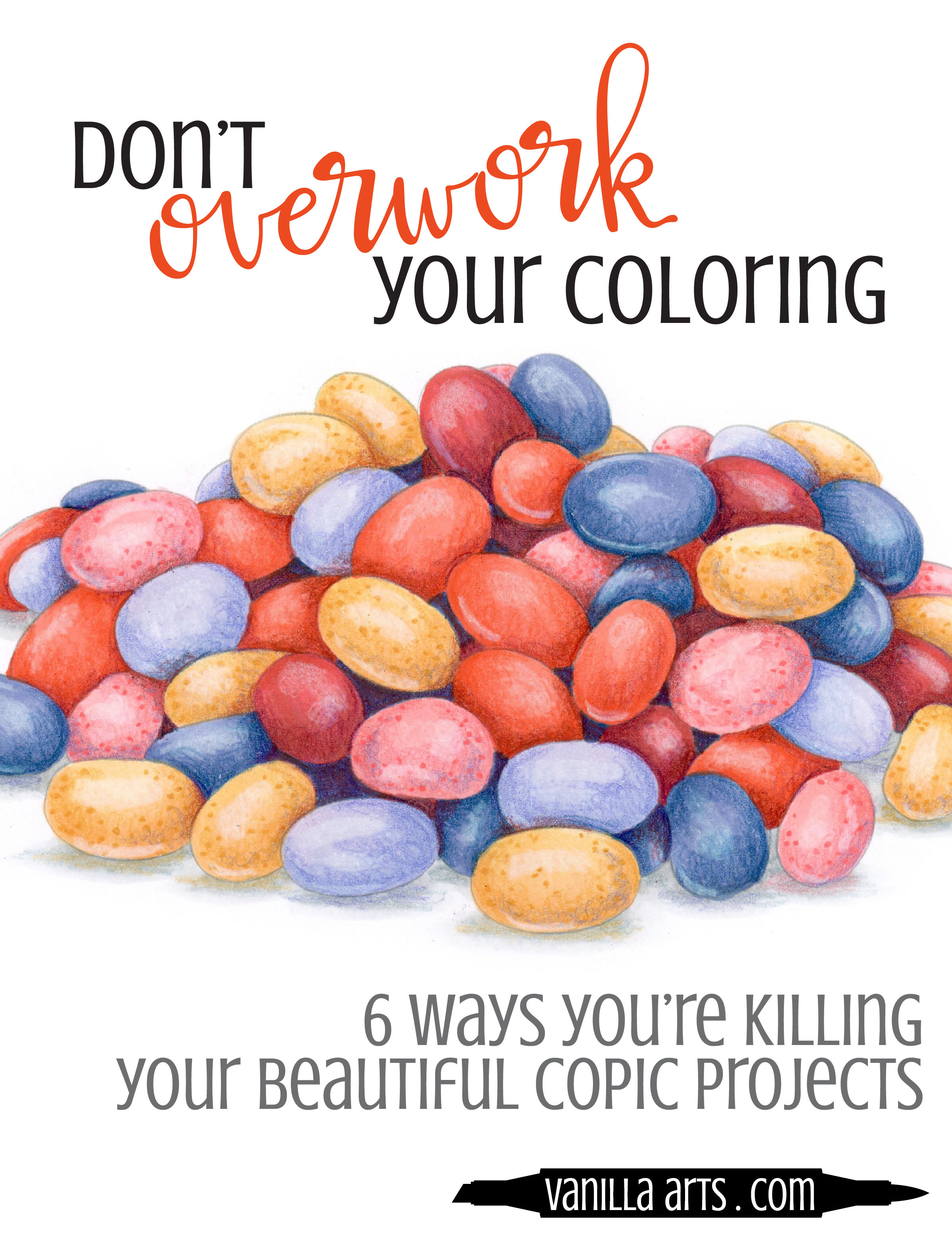
Just as an example, there’s one red jellybean in the pile here which bugs the heck out of me. Every time I look at this project, that jellybean pops right out at me and says “fix me now!!!”
Do you see the problem?
How can you not see it?
That’s the thing about mistakes, you're the one who made the mistake. You're the one with your nose hovering 2 inches away from the mistake.
You’re the only one obsessing about it.
We're all wondering what the heck you're fussing about.
We may not notice the mistake but guess what we can see?
We can easily see the spot you re-blended so many that it now looks dark and sticky. We see the places you scrubbed raw with an eraser. And that glittery butterfly sticker isn't fooling anyone. We know you're trying hide the fix of a fix of a fix.
If you fixed it once, that’s fine. Maybe you can get away with trying it one more time. But after a certain point, you’re hurting rather than helping. You can not fix everything.
Some mistakes are best left alone.
After the second fix, if it's still not right, make your peace with it.
Don't kill your whole project over a tiny flaw.
2. Outlining
Colorers all seem to share one very bad habit.
I think you love coloring so much, you don’t want the coloring session to end.
So as the project winds down, when you run out of stuff to color, most folks go back and outline everything.
You run a pencil around the outside of every shape. You reinforce all the edges.
There’s a weirdly satisfying feeling to trace over areas of beautiful coloring. It's like you're reliving the glory. You rocked that area once, now you’re experiencing it again.

It’s kinda like when people doodle in meetings or while talking on the phone. We draw a square and then trace over the square nine million times. It feels good.
People do this with their coloring projects all the freekin' time. They sit there with an odd smile on their face, running the pencil or marker over the area repeatedly.
Hey, snap out of it! Stop!!!
What's the quickest way to make something look fake?
Put a big ol' outline around it.
The Mona Lisa wouldn't look quite so hot if her nose and both nostrils were outlined in dark heavy scribbles, eh?
If you're sitting there tracing the original line drawing… Hello? You're done.
Walk away before you damage it further.
3. Air Flourishes
I joke with students about "Jaques" the stereotype artist. He's the starving French artist guy in a striped shirt with a beret, red neckerchief, and a handlebar mustache.
Oui, oui! Everyone knows Jaques!
Close your eyes, I know you can picture him too.
When Jaques paints, he waves his paintbrush around in the air, drawing lots of attention. He makes fancy swishes as if he's conducting the orchestra at the Kennedy Center.

We do zee swish-swish and ooh la la! Magnifique!
Pssttt… real artists don't work that way.
But colorists sure do!
When I see a student making air flourishes, I rush over to stop them.
I don’t know why sooooo many people do this. You can't color well if you're flopping your arms around like an octopus after his sixth cup of coffee.
Any marks you make will be sloppy and out of control.
If you're waving your hands in the air, you are not coloring well.
For some reason, colorers like to go all Beethoven with their final strokes. Mad jabs and a few swoops feel like an artistic way to end the project.
But that's not joie de vivre. you're making big bold mistakes.
On purpose!
Stop. Just stop before you mess it up more.

4. Doodles

Knock-knock!
Who's there?
Elephant!
Elephant who?
Elephant with daisies and stars and little pink hearts floating around in the background!
My joke didn't make sense, did it?
Neither does the card you just made.
Pointless decoration detracts from your coloring.
If you're doodling confetti dots, adding speckles and freckles, or if you are drawing motion lines behind your characters like you see in the comics... stop!
You are ruining your project.
Don't do that!
5. Extreme Highlighting
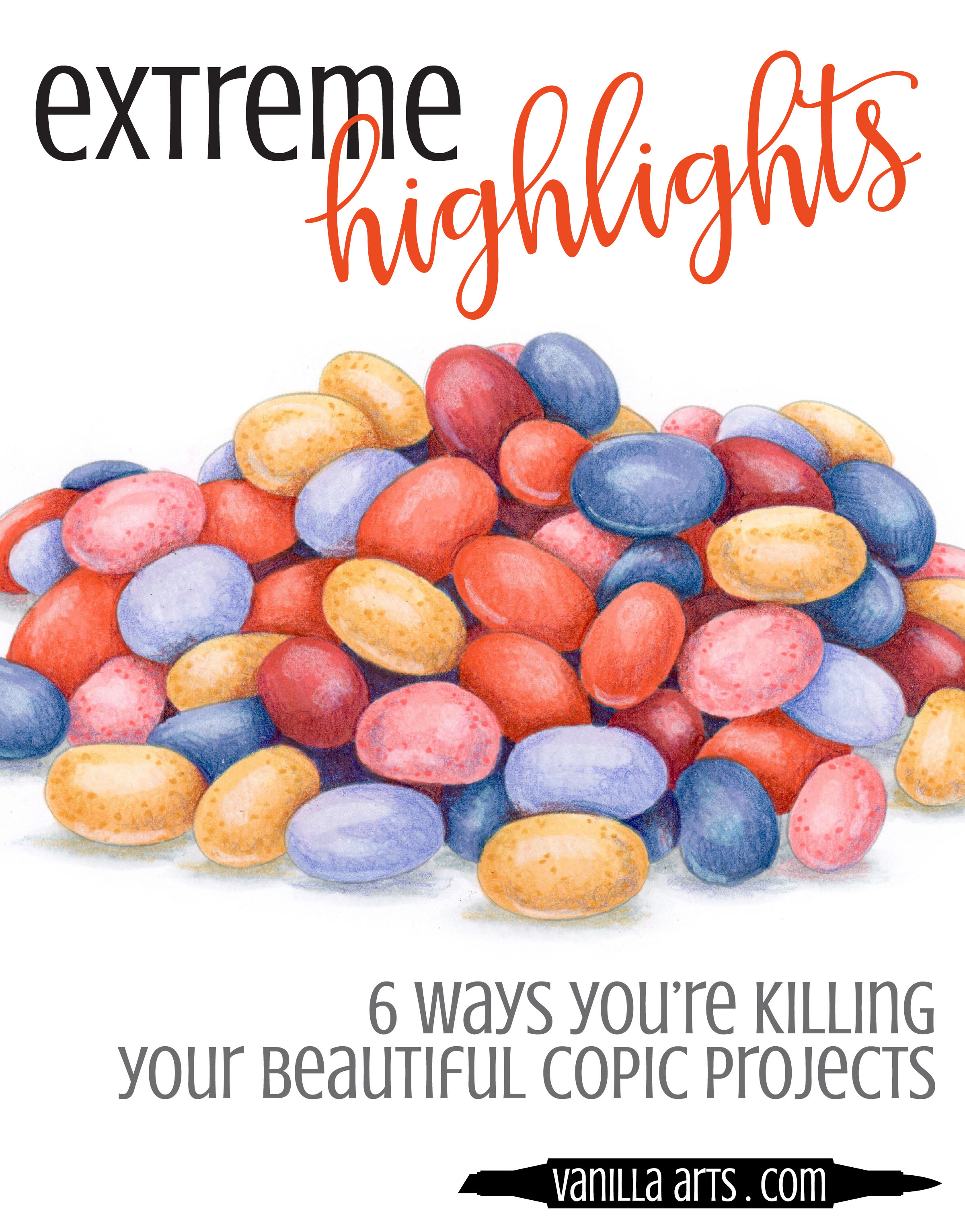
Most colorists end every project with a white gel pen.
A lot of white gel pen.
Don’t look all innocent, you know you do it.
You could happily spend weeks adding little white comma shapes to everything. Every. Thing. You’d highlight the toes on a ladybug and each of her eyelashes if you could.
Pssttt… highlights do not create realism, depth, or dimension.
Over-highlighting is like scoring an own-goal. You're hurting the cause.
Not everything needs a highlight.
I'm thinking of starting a 12 step program for folks who love their gel pens just a little tooooooo much.
That stuff is getting out of control.
COLOR JELLYBEANS WITH ME

6. Day Dreaming

I'm going to give this unicorn card to sweet little Justin and he will love it so much! He'll sleep with the card under his pillow every night until he's 27 years old knowing Nana loves him...
or
Janet will be so touched that I was "Thinking of Ewe". She'll show this card to all our co-workers. The staff will cheer and carry me on their shoulders to the Chairman's office and they'll loudly demand that I be promoted to the head of a new Coloring Department where I'll make sheep themed cards for all the major holidays...
Uhm, yeah. While you're thinking about all that stuff, you're not thinking about the marker that’s…
OMG, you’re still coloring!
Distracted coloring is bad coloring.
You can daydream or you can color but you can’t do both.
Move away from the table.
Don't touch the project until you're back on earth.
There you go!
Six major signs that you're overworking the project.
Knowing when to say when is a tough decision.
But if you're obsessively reblending, outlining, waving your hands around, doodling, daydreaming, or highlighting the heck out of it, it's a pretty safe bet that you're done.
And you've probably been done for a while.
While we can't rid the world of the overworking habit, you can learn to spot the signs in yourself. As you get to the end of a project, be aware of how your thoughts and movements change.
Don't let the cooling-off period be your downfall.
Watch for those little quirks and stop them before they kill your coloring.
Enjoyed this archived Vanilla Arts article?
My newer realism tutorials, color theory lessons, and coloring workshops now have a modern home.
→ Explore current tutorials and free resources at MarkerPencil.com