
Copic Marker R29 “Lipstick Red” (Coloring Tips for Classic Red)

What’s a Good Blending Combination for Copic R29?
I’ve used Copic Markers professionally for 30 years. After all this time, I know more than a few red blending combinations.
But I’m always sad when someone asks for a marker recipe.
There’s more to artistic coloring than Copic blending combinations.
To be honest, blending combos are the least of what we do.
Today, let’s look at Copic Marker R29 Lipstick Red from the artist’s perspective— how do I use this red marker in my classes and in my artwork?
Let’s get past the basic blending and find out how this marker really performs.

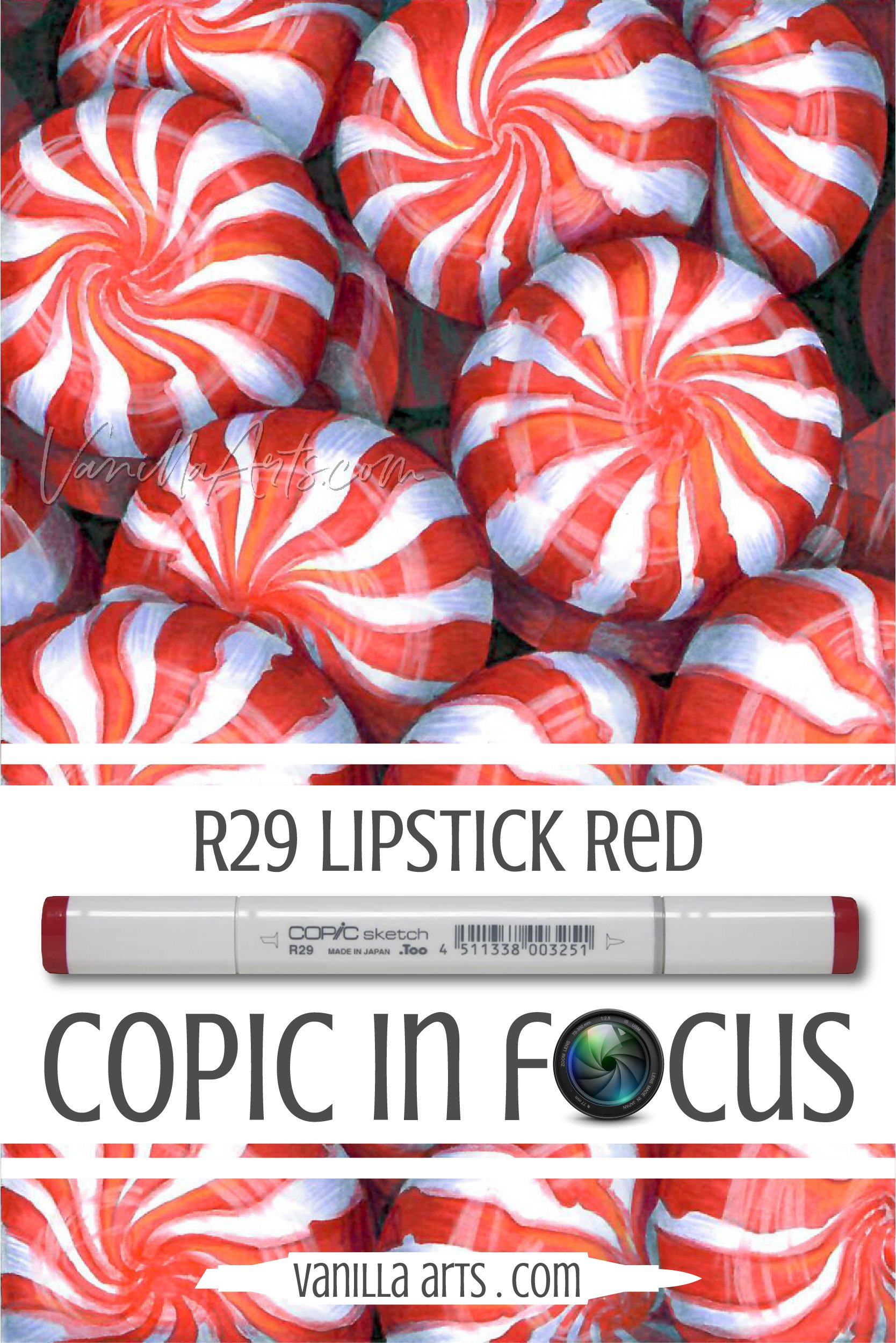
“Cool Peppermint” by the author, Amy Shulke. This project features R29.
Copic Marker R29 Lipstick Red is a classic red, perfect for coloring food, florals, and holiday items. I highly recommend this versatile color along with R27 as your first red purchases. R29 can be a stubborn blender, using high quality marker paper will improve the smoothness of R29 blends.
Copic R29 is a bright, classic red
When someone says “red”, we picture fast cars, fire engines, and Santa Claus. R29 was born to color all these things.
R29 Lipstick Red is the perfect red-lover’s red.

In the Cool Peppermint project shown here (now available at ColorWonk.com), I’ve used R29 to create the swirling red stripes on the starlight mint candies.
About the Red Color Family:
Red is one of the larger Copic Marker families and is designated with the letter R on the caps.
You’ll also see red ink used to make colors in the YR, RV, and VR families. Only the R marker family contains true reds.
About the Ink Group:
R29 is part of the #2 or the “Twenty” group of R Copic markers— the first number in the ID code tells you the group number.
In general, Copics starting with #2 tend to be vibrant but not as neon-bright as the #0 or #1 groups. The Twenties are often my go-to for colors that are “bright yet sophisticated”..
Learn more about the Copic Numbering system in my article at MarkerNovice.com here.
About the Color Value:
The second number in the code R29 is a 9.
This tells you that R29 is the most intense marker in the Twenty group (nine is always the darkest while 0 is the lightest).
The Copic R-Twenty family is larger than average with 6 markers: R20, R21, R22, R24, R27, and R29.
The thing to watch out for with Copics ending in a 9 is that they tend to be stubborn blenders. The ink formula is mostly colorant with very little solvent. Since solvent is what does the actual blending, markers that are dark tend to be harder to smooth.
Red inks in general are also staining— red ink grabs tightly onto paper fibers and is reluctant to budge. It’s not a Copic characteristic, all red inks from all brands are stubborn. Anything with an R on the cap will require more attention on your part to blend it smoothly.
Despite the fact that R29 is a stubborn and reluctant blending marker, I still highly recommend this marker for beginners because of its classic color. It’s hard to imagine coloring without this essential shade of red.
About the Name:
R29 is a bright traditional red, perfect for a little red dress and matching lipstick. The name “Lipstick Red” is a perfect description of this color.
Copic names don’t always make sense but this one does!
Is Copic R29 Ink Lightfast?
Does it fade quickly? Can it be erased? Does it shatter? Does the cap color match the ink color?
I’ve tested R29 ink to help you better predict how this ink will behave during use.
See the test results for:
Lightfastness
Layering
Color Build-up
Dilution
Value
Cap Accuracy
Behavior upon contact with Colorless Blender
MarkerNovice.com is the sister site to VanillaArts.com where I offer reliable information for Copic Marker beginners.

How Do I Use Copic R29 Lipstick Red in my Classes and Projects?
Red is my favorite color, so I tend to use reds more than the average colorer. But I have to admit, R27 is my favorite shade of red. It’s a bit lighter and brighter than R29.

I teach with reds a lot, even though reds are a stubborn-blending ink.
Actually, I teach with reds because they’re harder to blend. I figure if you can blend R29 smoothly, then everything else will be a piece of cake. So we practice R29 again and again in my classes.
R29 blends easier when combined with R27. R27 has more solvent in the ink formula which helps to smooth the R29 particles. R27 is the manipulative friend who can coax R29 into doing anything we want.
For advanced classes, we skip the R27 and jump to R24. This blend is harder but it creates a nicer gradient.
R29 to R24 is my favorite pairing for a red gradient but R29-R27-R24 is easier for beginners.
Read More:
Click to visit Amy’s articles which discuss coloring with red


How to Blend with Copic R29
Here are a few sample blending combinations using R29 Lipstick Red.

In the Self Blending swatch, I’ve applied one, two, then three layers of R29 to create a color gradient from just one marker. The darker left side is three coats of ink, the middle mid-tone is two layers, and the far right is one layer of ink.
People don’t often think about blending a marker with itself but self-blending is always the easiest gradient possible.
The Natural Blend is three markers which all share the same first number.
Here, we have R29 as the dark (far left) with R27 in the middle, and R24 on the right. This blend is popular in coloring classes and tutorials.
The Almost-Natural Blend uses R39 to add a darker value to the combination. This is also a very common blend.
The last swatch is my personal favorite. I often underpaint reds with blue or violet markers. B23 here gives a nice punch of murky darkness without overpowering the red. R29 goes over the top of the blue and R17 rounds out the trio for a punch of warmth at the end. I like to end my red blends with a slightly orangish red, it adds the feeling of sunshine.
Tips for blending R29:
Note: R29 is a slightly stubborn marker which will stain the paper. But as I stated earlier, if you can blend R29, you can pretty much blend anything. So keep practicing!
The entire R-Twenty family is a bit cool (meaning it leans more towards blue than yellow). This is why the markers like R22 and R21 at the low end look pinkish. This is why I switch to R17 in my favorite blend, it doesn’t shift the blend pink.
For beginners, R27 insures that R29 will behave. I highly recommend using R27 in your R29 based blending combinations until you get a feel for how much moisture is required to smooth R29.
Don’t over-ink with R29— it’s a staining color, so the more R29 you apply, the harder it’ll be to blend.
Anything more than four layers of R29 starts to look slightly rainbow-metallic from an angle (like oil-slicks on pavement).
If you’re working on copy paper (like the often-recommended Hammermill), drawing paper, or mixed-media paper— you’re encouraging R29 to misbehave! These papers are made with a high percentage of wood fiber. R29 is especially staining on wood. Switching to a paper developed for markers will help R29 blend better. Try X-Press It (affiliate link to Amazon).
The Most Important Tip for Coloring with Red Copic Markers:
Perhaps it’s because beginners have only a few markers to choose from or if this is a problem that stems back to elementary school when we were taught to mix red and white paint to make pink paint.
But anyway, I see a lot of people using RV markers to make light red because they don’t like the orange-ishness of some of the lighter R markers.
Anyway, the insistence of blending red with pink leads to problems when they try to color with realism.

Light red is not pink.
If you’re wondering why your projects have that cartoonish feel…
It’s because you’re shifting the red temperature cool when you add pink to a blending combination.
Pink is actually a light magenta. The entire magenta family is very cool compared to the warmth of red.
Highlights are the areas catching the sun. If you touch an object with strong highlights, it can feel physically warmer in the highlight. So it just looks weird when you use cool pink to highlight an area where we expect warmth.
And here’s the weird part… if I asked you to pick dark pink marker, nobody would grab an R marker…
So why do people pick RVs for light red?
I can’t explain it.
Dark pink is not red.
Keep your pinks distinct from your reds.
Light red actually looks peach in color. People are always puzzled by how peach R12 and R02 are, but that’s because you’re expecting pink.
Light red is warmer and more golden than pink.
And for the record, I think R85, R83, and R81 should be in the RV family. They’re not red because they’re not warm enough.
Shade and Highlight Suggestions for R29 Lipstick Red Copic Marker
If you’ve read many articles here or taken any of my classes, you know I teach the underpainting method.
In underpainting, we choose opposite colors on the color wheel to add the realistic murkiness found in real-life shade. We “desaturate” with complementary colors. Read more in my article series here.

After I underpaint and blend with Copic markers, I then add colored pencils to boost the shade and add highlights. My pencils rarely match the Copics.
Shade suggestions for R29 Lipstick Red:
Copic Underpaint Suggestions: BG13, BG72, B23, B32 or B34, BV20, BV13, V04, V12, or V20.
Unlike most Copic instructors, I do not recommend shading R29 with R59 or R89. Yes, they’re deeper reds but they’re too cool. If you must add a darker red to the blending combination, R39 is the best option.
Prismacolor Pencil Overpaint: PC931 Dark Purple, PC937 Tuscan Red, PC1095 Black Raspberry.
Highlight suggestions for R29 Lipstick Red:
Lighter Copics: Try the Vanilla combo shown above (B23, R29, R17) but add a marker to the light end. I like continuing with R14 and R12 for an ideal spectrum of red.
Prismacolor Pencil Overpaint: PC 914 Cream, PC1012 Jasmine, PC927 Light Peach, or PC938 White.
Is Copic R29 a Good Marker for Beginners?
Yes. I think R29 should be your first red purchase along with R27 and R24.
It’s a great value too! You can color for a very long time with just this one red blending combination.
I teach beginner classes with R29 because it’s a classic red but also a great opportunity to teach how to handle stubborn blending markers.
R29 is on my starter list here and it’s the red we use in my beginner course here.

“Cool Peppermint” by the author, Amy Shulke. This class is now available in Color Wonk.

Cool Coloring
Join Amy for a fun lesson on realistic shading and underpainting for realism
“Cool Peppermint”
Learn to color striped objects using the universal shading technique which strips away the clutter from the normal blending combination theory of shading. You’ll color faster with more realistic results!
Intermediate Skill Level
Copic Marker + Prismacolor Premier Colored Pencils
Anytime access, work at your own pace.
Class Printable Pack Includes:
Digital line art
Class syllabus with detailed recipe guide
Photo references, WIP photos, and learning aids

Select supplies used in Cool Peppermint:

Vanilla Arts Company is a participant in the Amazon Services LLC Associates Program, an affiliate advertising program designed to provide a means for use to earn fees by linking to Amazon.com.
